How to Score Darts
A comprehensive guide to understanding the dartboard and recording scores for CCCCDA events
Darts scoring is described here for the matches most people will play. This is a standard version of the game where players must start and finish with a Double scoring dart. The score to begin is 501. Players' scores are deducted from 501 with the aim being to finish the game as fast as possible, scoring a Double on the last dart to make the score 0.
The Dartboard
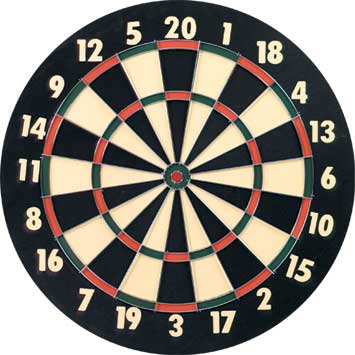
This standard dartboard clearly shows the segments associated with each number on the board. Landing a dart in the "20" segment scores you 20 points. Simple. You do need to know the value of the different concentric rings around the board. Please read on.
Single Scores
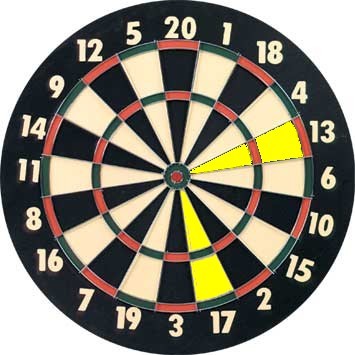
For any dart landing in the "non-ringed" area of the dartboard, you score the number shown at the outside of that segment.
Example
Darts landing in the yellow shaded areas would score 13 and 17.
The Double Ring
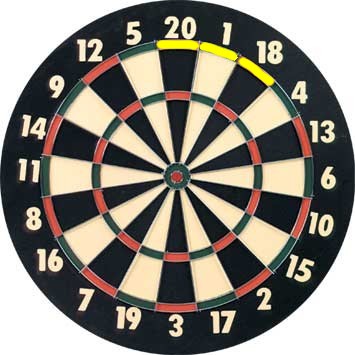
The outer ring counts as double the normal score, usually written as D.
Example
The yellow highlighting shows D20, D1, and D18.
This is double the normal score of 20 + 1 + 18 = 39.
The Triple Ring
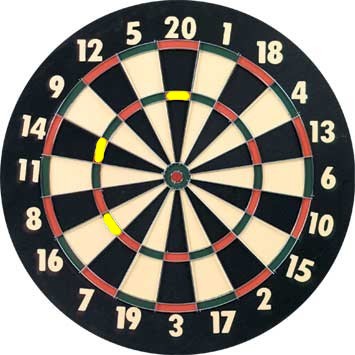
Any darts landing in the inner ring score three times their normal value, usually shown as T.
Example
Darts landed in the yellow shaded areas would score T20, T14, and T16.
This triples the normal score of 20 + 14 + 16 = 50.
🏆 The 180 Badge
You can increase your score quickly if you can hit the larger numbers in the Triple ring. People scoring 3 × T20 in a regional competition may be entitled to a 180 badge as this is the highest scoring shot in darts and is difficult to achieve, especially under competition pressure.
Outer Bull
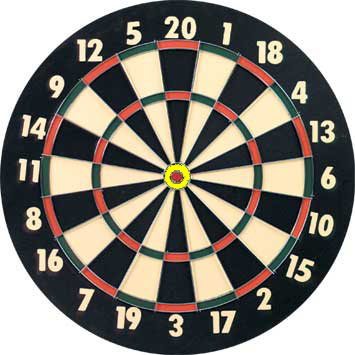
The outer bull, shaded in yellow, scores 25 points.
Inner Bull
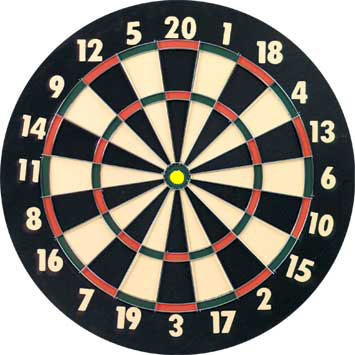
The inner bull, shaded in yellow, scores 50 points. This is the point on the board aimed at during the "bull up" which determines the team playing order.
Recording Darts Scores
Recording scores is easy but does require the ability to multiply, add, and subtract. When the player has thrown their three darts, the score is added up. The total is then subtracted from the team total to produce a current score.
Example
A player scores D5 (double 5), 20, and 1. The total is 10 + 20 + 1 = 31.
This method of scoring continues all the way to the end of the match. However, once your score falls to 170 or below, it may be possible to finish the game with 3 darts.
Finishing the Leg
To finish the leg, you need to finish on a double. If you score more than, or 1 less than, the required total with three darts, your score will not be counted and the previous score will stand.
Need Help Finishing?
When you're at 170 or below, consult a three dart finishing guide to find the best way to finish the game as quickly as possible.
View Full RulesReady to Play?
Now that you understand how to score darts, why not find a club and start playing?